Cardiac amyloidosis presenting as refractory heart failure: Role of GLS in diagnosis and on follow up
DOI:
https://doi.org/10.21542/gcsp.2026.7Abstract
Background: Cardiac amyloidosis represents a challenging diagnosis in patients with multiple myeloma, often presenting as refractory heart failure with subtle early manifestations that can delay appropriate treatment.
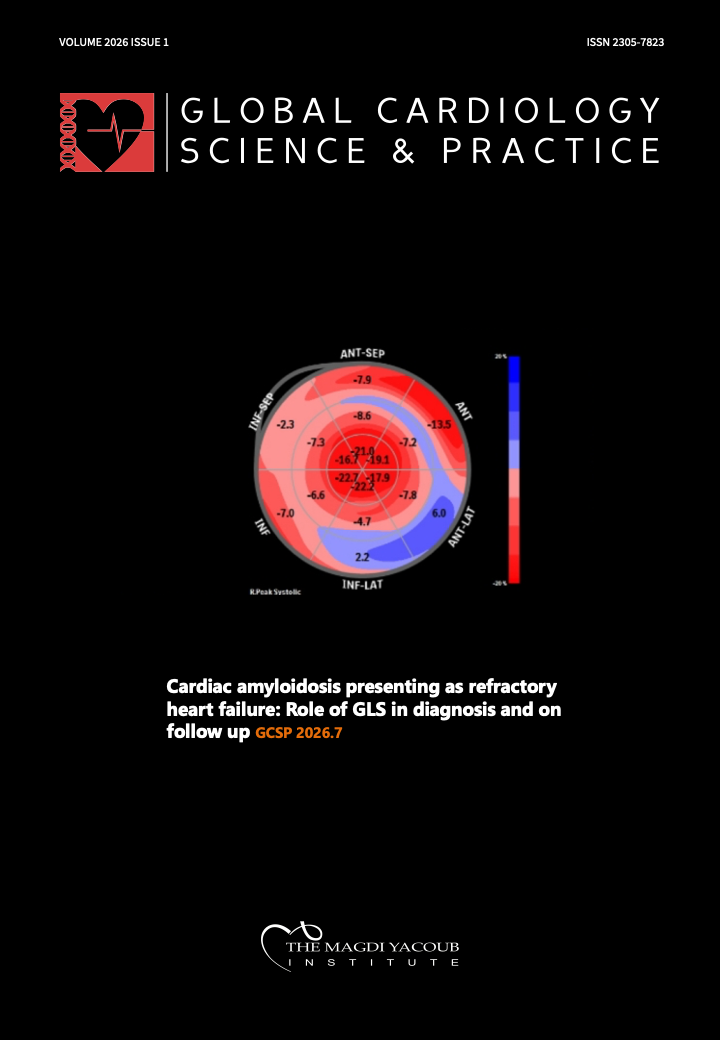
Case: We report a 55-year-old male with a three-year history of multiple myeloma who presented with progressive dyspnea and bilateral lower limb edema. Despite being normotensive and non-diabetic, he exhibited clinical signs of volume overload with elevated jugular venous pressure and bilateral crepitations. Electrocardiography revealed left ventricular hypertrophy with strain pattern, left axis deviation, and left bundle branch block, raising suspicion for infiltrative cardiomyopathy. Transthoracic echocardiography demonstrated moderate concentric left ventricular hypertrophy with reduced ejection fraction (40%) and severe grade III diastolic dysfunction. Global longitudinal strain analysis revealed markedly reduced GLS at -9.7% with characteristic apical sparing pattern, creating the pathognomonic "cherry-on-top" appearance. Despite optimal heart failure management and continued multiple myeloma treatment, six-month follow-up demonstrated dramatic GLS deterioration to -1.9% , indicating progressive cardiac amyloidosis and poor prognosis.
Conclusion: Global longitudinal strain serves as both a sensitive diagnostic tool and powerful prognostic marker in cardiac amyloidosis secondary to multiple myeloma, supporting its integration into routine cardiac surveillance protocols for patients with plasma cell disorders to enable earlier diagnosis and better risk stratification.
Downloads
Published
Issue
Section
License
Copyright (c) 2026 Sridevi Chigulapalli, Susheel Malani, Prakyath Shetty

This work is licensed under a Creative Commons Attribution 4.0 International License.
This is an open access article distributed under the terms of the Creative Commons Attribution license CC BY 4.0, which permits unrestricted use, distribution and reproduction in any medium, provided the original work is properly cited.