Rare case of fulminant myocarditis in a patient with ricketssia infection.
DOI:
https://doi.org/10.21542/gcsp.2026.15Abstract
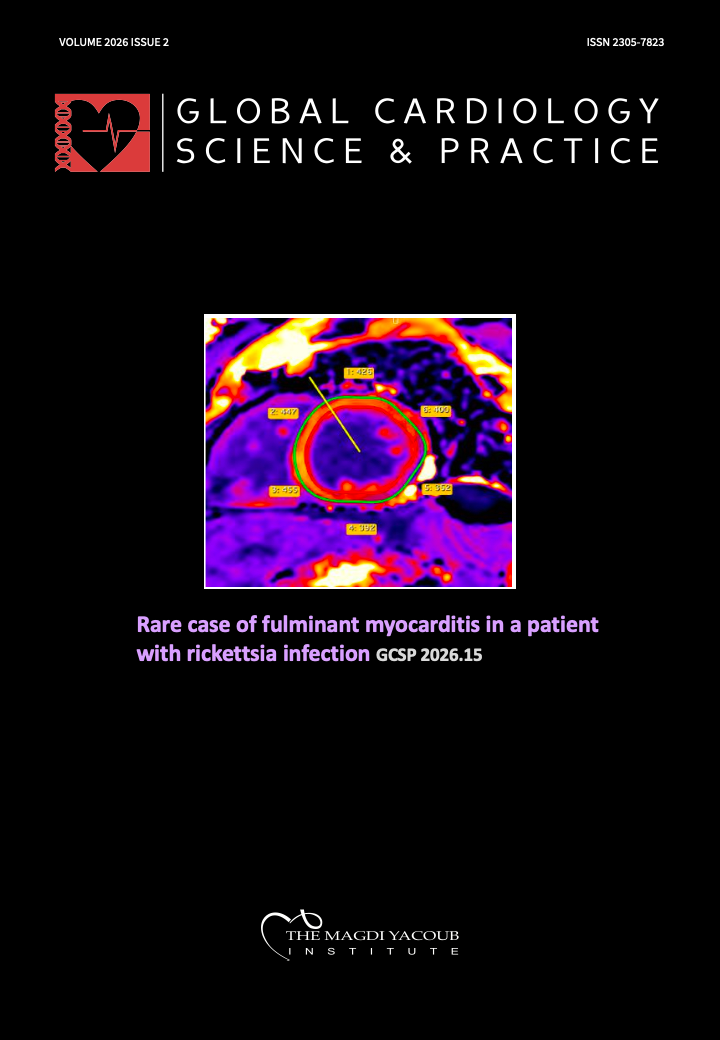
We report a rare case of fulminant myocarditis caused by Rickettsia conorii infection in a 31-year-old previously healthy male from rural Greece. The patient presented with acute chest pain, fever, and an insect bite eschar. Initial electrocardiography (ECG) demonstrated inferior ST-segment elevation, and coronary angiography excluded obstructive coronary artery disease. Within 24 hours, the patient deteriorated to hemodynamic collapse, with left ventricular ejection fraction (LVEF) declining to 20–25%. Management included doxycycline, empirical broad-spectrum antibiotics, intravenous corticosteroids, and aggressive diuresis. Serological confirmation of R. conorii infection (IgM titer 1:64) directed targeted antibiotic monotherapy. Cardiac magnetic resonance (CMR) imaging performed two days post-discharge confirmed acute myocarditis per the 2018 Updated Lake Louise Criteria, with extensive late gadolinium enhancement (LGE) involving 28% of LV mass. LVEF recovered to 56% within weeks. This case highlights the potential for R. conorii to precipitate fulminant myocarditis even in immunocompetent young patients, underscoring the importance of clinical suspicion in endemic regions.
Downloads
Published
Issue
Section
License
Copyright (c) 2026 Nikolaos Tsiamis, Dimitrios Afendoulis, Christos Tountas, Eleftherios Vidalakis, Georgios Totikidis, Flora Tsakirian, Konstantinos Toutouzas, Anastasia Kitsiou

This work is licensed under a Creative Commons Attribution 4.0 International License.
This is an open access article distributed under the terms of the Creative Commons Attribution license CC BY 4.0, which permits unrestricted use, distribution and reproduction in any medium, provided the original work is properly cited.