Foreword to the Special Issue
DOI:
https://doi.org/10.21542/gcsp.2026.s2.forewordAbstract
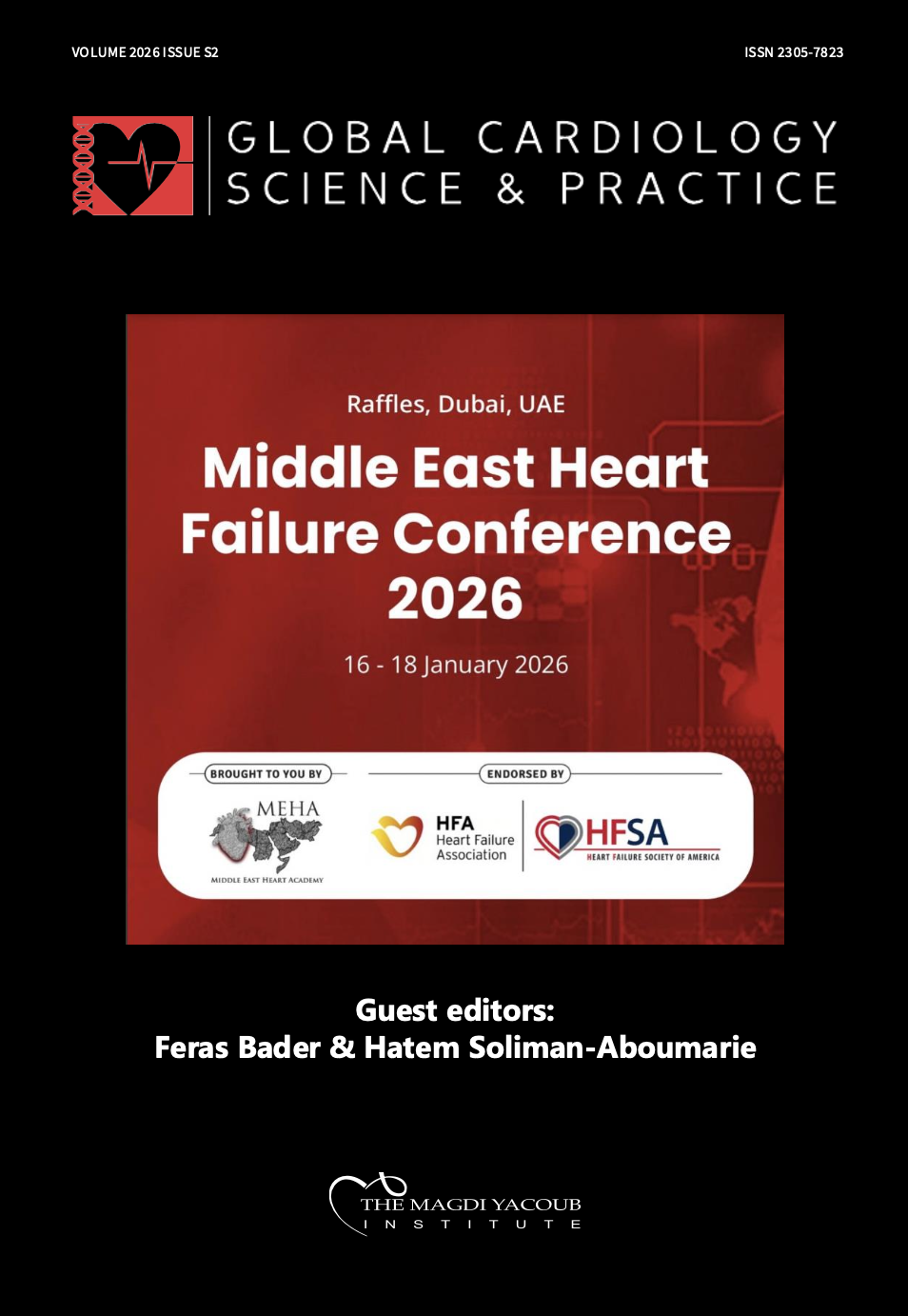
The Middle East Heart Failure Conference (MEHFC) has, over the past decade, evolved into a flagship scientific gathering that not only reflects the rapid maturation of heart failure care in the region, but actively shapes it. Hosted by the Middle East Heart Academy (MEHA), the conference has consistently brought together a vibrant community of clinicians, scientists, surgeons, and allied health professionals in Dubai, UAE - creating a rare space where global expertise meets regional priorities. Its unique endorsement by both the Heart Failure Association of the European Society of Cardiology (HFA- ESC) and the Heart Failure Society of America (HFSA) underscores its international credibility and growing influence.
The 2026 edition marked a defining milestone. With nearly 100 distinguished faculty members representing 21 countries, abstract submissions from 17 nations, and over 900 attendees from across the Middle East and beyond, the meeting achieved unprecedented scale and impact. More importantly, it reflected a shift - from knowledge dissemination to knowledge generation, collaboration, and regional leadership in heart failure science.
A highlight of this success was the presence of Professor Sir Magdi Yacoub as the main keynote speaker, who was awarded the MEHA Lifetime Achievement Award. His participation carried significance far beyond ceremony. As one of the most influential figures in global cardiovascular medicine, his lifelong commitment to advancing cardiac care, particularly in underserved regions, resonates deeply with the mission of MEHFC. His vision has always extended beyond surgical excellence to encompass education, research, and sustainable capacity building.
Central to this vision is the Magdi Yacoub Institute at Harefield Hospital in London, UK, which continues to play a pivotal role in transforming cardiovascular care through science and education. The Institute stands as a model for how integrated efforts in research, training, and clinical innovation can address complex challenges such as advanced heart failure and transplantation. By fostering multidisciplinary collaboration and nurturing the next generation of clinicians and scientists, it bridges the gap between discovery and real-world impact.
The importance of such initiatives cannot be overstated in the context of the Arab World and the broader Middle East. The region faces a growing burden of cardiovascular disease, with heart failure emerging as a major public health challenge - often presenting at a younger age and with more advanced disease. Despite remarkable progress at certain centres, lack of access to advanced therapies, including mechanical circulatory support and transplantation, remains significant. Promoting cardiovascular research and education in this domain is therefore not a luxury - it is a necessity.
Looking ahead, the opportunity lies in leveraging this momentum to build sustainable ecosystems of excellence. This includes strengthening training pathways in heart failure and transplantation cardiology, expanding registries and research collaborations, and advocating for health system reforms that improve access to life-saving therapies. It also means empowering young clinicians and researchers across the region to lead the next wave of innovation.
This collaboration between the Magdi Yacoub Institute and the Middle East Heart Academy reflects a shared commitment to advancing the entire continuum of heart failure and transplantation care. It embodies a collective ambition to strengthen clinical pathways, expand access to include all impacted patients, and accelerate research that informs better, more equitable care both within the Middle East region and far beyond.
Published
Issue
Section
License
Copyright (c) 2026 Feras Bader, Hatem Soliman-Aboumarie

This work is licensed under a Creative Commons Attribution 4.0 International License.
This is an open access article distributed under the terms of the Creative Commons Attribution license CC BY 4.0, which permits unrestricted use, distribution and reproduction in any medium, provided the original work is properly cited.